


Sophie Wells always believed soccer was the place where she became her best self, but by the end of her time at the University of Lynchburg, it had become the place where she was losing herself. It wasn’t one moment that broke her; it was the slow accumulation of them. There was criticism that didn’t teach, benching that didn’t make sense, and silence where there should’ve been support. There was a feeling that no matter how hard she worked, she wasn’t good enough.
Some moments cut deeper than others. Wells remembers one game under stadium lights when she felt she had done everything right – staying sharp, staying ready, so prior to the game – the coach had promised her that this game she would be getting the chance to play and prove herself. This was gonna be her breakthrough, she thought. However, the opportunity never came. Instead, the coach subbed in another player. She felt her heart drop.
“I just looked at my friend and said, I can’t do this anymore,” Sophie said. “I started tearing up, and she just grabbed my hand and said I know, I’m sorry.”
This was a turning point. Soccer, once her safe place, had quietly become something she braced for. She stopped trusting her instincts, stopped believing in her abilities, and stopped recognizing the confident player she used to be.
“I used to play free,” Wells said. “ Now I was scared to make mistakes, because mistakes weren’t taught there… they were punished.”
Her mental health cratered, practices felt suffocating. Wells did the thing that once felt unthinkable; she handed in her gear, found her coach, and said the words “I quit.”
She had arrived at Lynchburg as an attacking outside back. The kind of player who was gritty, pushed forward, created chances, and trusted her instincts. But her creativity was not rewarded. For the Hornets, confidence was not built; it was dismantled.
“The coach told me the way I played was wrong,” she said. “No dribbling forward. No attacking runs. Don’t trust yourself that much. You’re not fast. You’re not good enough at that…over and over.”
The words stacked like heavy bricks. Soon, soccer stopped being where she felt most alive, even though it was something she truly loved. “I lost my starting spot because a goal was scored on the opposite side of the field,” she said. “It wasn’t about ability. I was basically exiled to the bench and lost opportunities.”
Even her personal life wasn’t safe from the pressure. When she lived through an assault and was navigating legal hearings, she wasn’t met with compassion. She was met with a timeline. “I was told I had one week to prove myself or I’d be cut. That wasn’t after a bad game. That was after something that changed me as a person,” she said. “I had no support. None.”
Wells’ experience at Lynchburg didn’t change her genuine love for soccer, but rather just how she viewed herself as a soccer player. “It got to the point where putting my cleats on gave me panic attacks,” she said. “I just thought I wasn’t worth it anymore, or I wasn’t good and that I didn’t deserve to play soccer anymore.”
The decision to transfer wasn’t easy. The process felt scary and uncertain – like stepping into the unknown. But Wells knew it was what she needed. “If I’m being honest, my mental health was down the drain. I just saw I had no support system,” she said.
However, soccer was deeply tied to who she is as a person and her personality. It had been her identity for so long that losing it felt like losing a part of herself. The choice to transfer may not have felt bold at first. It felt shaky. “I wasn’t scared of soccer anymore,” she said. “I was scared of starting over. New school. New team. New people.”
But staying at Lynchburg meant no more soccer, so she made the leap.
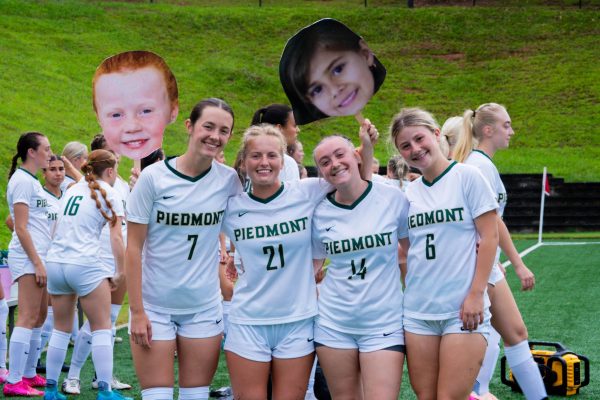
Wells transferred to Piedmont University to play soccer before her senior season, scarred from what she had gone through at Lynchburg. Walking into Piedmont’s locker room for the first time, she braced for the familiar: judgment, distance, hierarchy. Instead, she was met with laughter, hugs, loud introductions, and warmth. It felt foreign and freeing.
“They told me, ‘Be you. Play your game.’ No restrictions. No ‘you’re not enough.’ Just, ‘Do what makes you great.’ It was eye-opening. Like every single… baggage had been lifted off my shoulders.”
Even a preseason MCL injury couldn’t steal that peace. Her teammates checked in. Her coaches showed up. “You could hear how much they cared,” she said of the sideline energy that defines Piedmont soccer. “It’s not forced. It’s real.”
And at the center of that support was head coach Timmy McCormack, a former transfer athlete himself, McCormack knew the emotional weight of starting over, and gave Wells’ the care and support she deserved. “I could text him, ‘I’m anxious, I hope I’m doing enough,’ and he’d listen,” she said. “I was finally allowed to speak” Wells explained.
“Sophie transferring into our women’s soccer program was a great blessing for us, but I also think it had a positive impact on her as well,” McCormack said. “As someone who transferred twice in college, I understand the emotional challenges and obstacles that come with a change of scenery. Her transfer to Piedmont gave her a fresh start and allowed her to just be herself.”
McCormack saw her confidence return in real time, not just in soccer, but in every part of her life. “When a player can just be themselves, they find the confidence to succeed both on the field and in the classroom,” he said. “She’ll be taking a master’s degree with her when she leaves Piedmont. That’s the most important part to me — and it’s an advantage she might not have had if she hadn’t chosen to transfer here.”
While Piedmont women’s soccer changed Wells’ life, her impact on the team has been equally profound. “Sophie has been such a huge part of our team these past three years,” senior captain Sierra Judson said. “She’s gritty, creative, and always vocal, and her energy just spreads to everyone around her. She makes us all better and brings a spark to every practice and game.”
It wasn’t just coaching. It was the culture. Competitiveness without cruelty and support that didn’t disappear when she struggled. “I was just so in love, and so proud and happy,” Wells said. “I was always enjoying my experience. I had a good environment. I had friends. I had people around me who cared about me.”
For the first time in a long time, soccer wasn’t the thing that hurt her. Instead, it became her comfort zone once again. She felt at home with the Lady Lions, in a supportive environment by people who cared about her.
Transferring to Piedmont felt like starting her soccer life over again. What she didn’t expect was to fall back in love with the game so quickly. When the 2023 season ended, Wells wasn’t ready to let go of this aspect of her life. “ I instantly was like… I don’t want to be done,” she said. “I do not want to be done. I didn’t get my time at Lynchburg, and my time here at Piedmont has been so extraordinary. I was literally told I was glowing. That I looked so much happier, like myself again.”
“I talked to Timmy about trying to find a way to have another season,” she said. “And that was just the beginning.”
The path to another year meant appealing to the NCAA for a mental-health waiver, a process she didn’t fully understand until she was living it. Before the NCAA would even review her case, she first had to be approved by the Collegiate Conference of the South. Only then could the real paperwork begin. “And then I had to write an even longer statement,” she said. “Explaining everything that happened – the coaching problems, reporting my coach, why I didn’t get what I needed there.”
After trying to put the past behind her, Wells suddenly found herself having to recall one of the worst experiences of her life.
“I had to basically prove I was struggling,” she said. “Which meant reliving everything. Writing the assault in detail. Everything the coach ever said to me, that I wasn’t good enough, that I’d never play, that my efforts didn’t matter because I wasn’t worth putting on the field.”
She submitted it in June, but what followed was an exhausting, unending silence. “It was a waiting game. Forever, forever, forever,” she said. “They’d get my stuff, send it back, and I’d have to resubmit it again. There was no timeline, no estimate. I just didn’t understand why it was taking so long to give me a yes or no.” It was a very anxious process with alot being unknown.
Meanwhile, Piedmont’s season had already begun without her.
“It got to a point where I told my boyfriend, ‘I just don’t think this is in the cards for me. Maybe it’s time to let go and find something else.’”
Then, finally the answer came.
“They said yes, I was like… holy- they actually said yes. It felt like one in a million.”
She instantly packed and headed back to Demorest where the team was ready to welcome her back with open arms so she could play a final season of college soccer.
If Lynchburg tried to take soccer from her, Piedmont handed it back. Piedmont gave her a second chance at the sport she loved. But more than that, it gave her a second chance at herself. It meant more than goals, minutes, or stats, Piedmont gave her a forever community.
Despite all her hardships, Wells’ strength and resilience led her to finding herself again on the field, growing into every role she was asked to fill. During her time at Piedmont she thrived, earning all-conference, all-tournament, all-academic, and all-region honors – all while playing the game her way.
“Knowing that where I started and where I ended are so different, it’s shaped me so much as a person,” she said. “Having the opportunity to come here and play, it’s been amazing.”